

Why it matters: In 2026, AI coding tools have moved from “autocomplete” to “autonomous engineer.” Tools like GitHub Copilot, Google’s Gemini Code Assist, and OpenAI’s Codex can now generate entire applications from natural language prompts.
The human impact: Entry-level coding jobs are transforming. The new skill is no longer writing code — it’s directing the AI that writes it. By 2030, Gartner predicts that 80% of code will be generated by AI, not humans.
What to watch: The rise of “Prompt Engineering” as the most valuable skill in the job market.
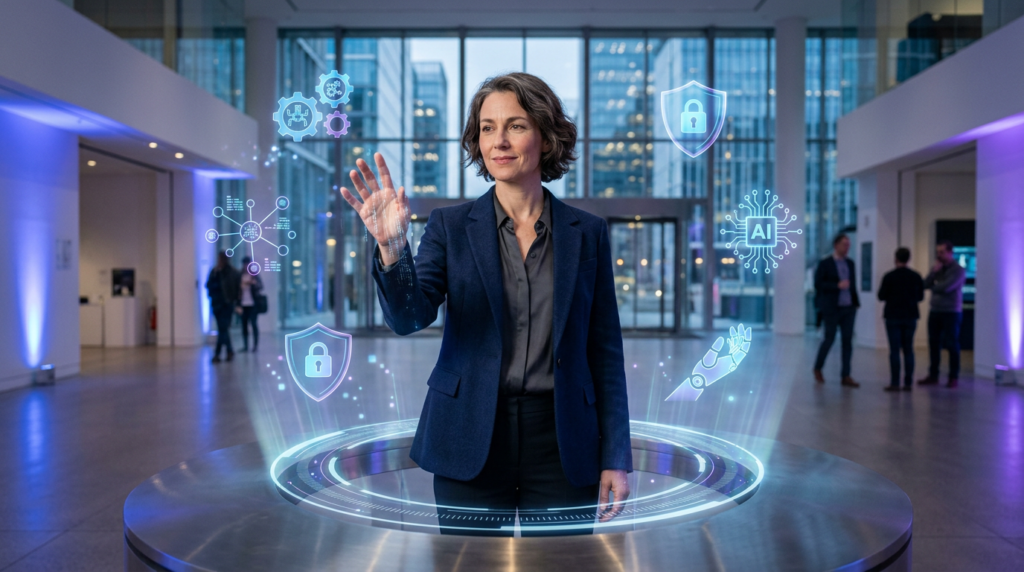
2. Multiagent AI Systems: The End of Single-Brain AI
Why it matters: Gartner named Multiagent Systems one of the top strategic trends for 2026. Instead of one monolithic AI model, companies are deploying teams of specialized AI agents that communicate, negotiate, and collaborate with each other — just like human teams.
The human impact: Your next “coworker” might be a team of 10 AI agents. 66% of companies already report measurable productivity gains from agentic AI. The question is: how do you manage, trust, and lead a hybrid human-AI workforce?
Stat: The agentic AI market is growing at 43.84% CAGR through 2034, according to industry analysts.
3. Physical AI: Robots That Learn Like Humans
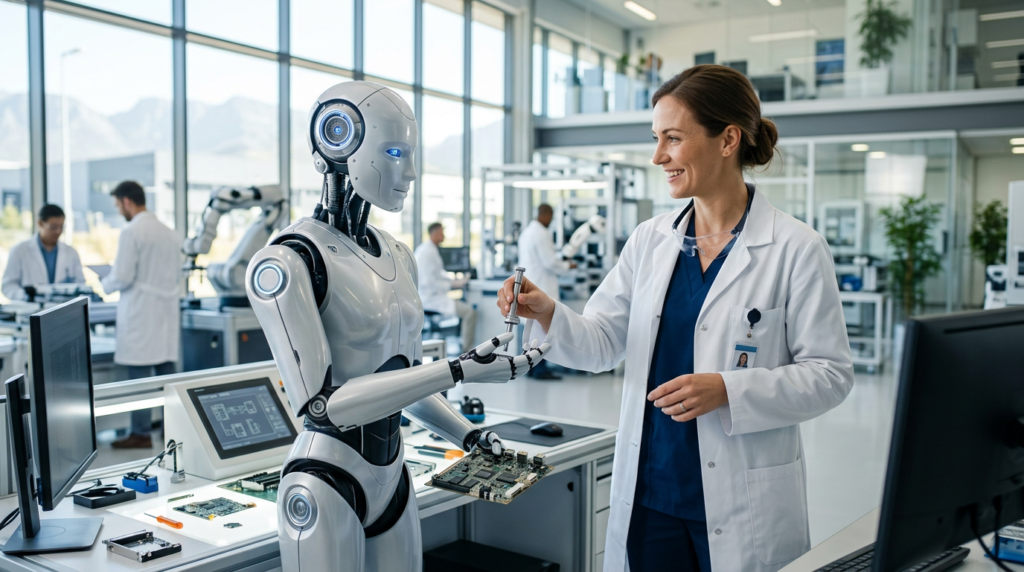
Why it matters: Physical AI is the fusion of robotics with generative AI. Robots are no longer programmed for one task — they learn by watching, just like humans. In 2026, companies like Figure, Tesla, and Boston Dynamics have deployed humanoid robots in warehouses, factories, and even homes.
The human impact: The “labor shortage” narrative is shifting to “labor transformation.” Physical AI will handle repetitive physical tasks, freeing humans for creative and strategic work.
Image suggestion: A photorealistic humanoid robot handing a tool to a human worker in a sunlit factory — collaboration, not replacement.
4. Hyperscale AI Data Centers: The Invisible Infrastructure
Why it matters: MIT named hyperscale AI data centers a breakthrough technology. These massive facilities — some consuming as much electricity as small cities — are the backbone of the AI revolution.
The human impact: Every time you use ChatGPT, Gemini, or Claude, you’re drawing power from these centers. The environmental cost is real. By 2027, AI data centers could consume 10% of global electricity. The question: can we innovate fast enough to make them sustainable?
5. Domain-Specific Language Models (DSLMs): AI That Speaks Your Industry
Why it matters: Gartner highlighted DSLMs as a key trend. Instead of one generic AI that knows a little about everything, companies now deploy AI models trained specifically on their industry — medical AI that only knows healthcare, legal AI that only knows case law, financial AI that only knows markets.
The human impact: These specialized AIs will become your expert colleagues. A doctor will consult a medical DSLM before diagnosis. A lawyer will ask a legal DSLM for precedent. The question is: who validates these models?
6. Preemptive Cybersecurity: AI That Predicts Attacks Before They Happen
Why it matters: Gartner’s “Preemptive Cybersecurity” trend is a direct response to the AI-powered hacking arms race. In 2026, cyberattacks are increasingly automated. The only defense is an AI that predicts and neutralizes threats before they materialize.
The human impact: Your digital identity is your most valuable asset. As deepfakes become indistinguishable from reality, knowing how to protect your “digital twin” is no longer optional — it’s survival.
Stat: Deloitte reports that while agentic AI adoption is set to rise 51%, only 1 in 5 companies has mature AI governance in place.
7. Mechanistic Interpretability: Finally Understanding How AI Thinks
Why it matters: MIT named mechanistic interpretability a breakthrough. For the first time, researchers are reverse-engineering neural networks to understand why AI makes the decisions it does. This is the “black box” being opened.
The human impact: Trust. Without interpretability, we cannot trust AI in critical domains like healthcare, law, and finance. This breakthrough is the key to unlocking AI’s full potential in society.
8. Digital Provenance: The Truth Machine for the Post-Truth Era

Why it matters: Gartner’s “Digital Provenance” trend addresses the biggest challenge of 2026: knowing what’s real. Blockchain-based provenance systems track the origin of every piece of content, code, and data.
The human impact: We’re entering a world where proof of authenticity is more important than the content itself. Your ability to prove that a video was really you, or a document was really signed by you, becomes a fundamental human right.
9. AI Security Platforms: The Guardian of the AI World
Why it matters: As companies rush to deploy AI, security has become the bottleneck. Gartner predicts that AI security platforms will become mandatory infrastructure within 24 months.
The human impact: Every employee who uses AI at work needs to understand basic AI security. The “human firewall” — you — is the first and most important line of defense.
10. Confidential Computing: Your Data, Encrypted, Always
Why it matters: Gartner listed Confidential Computing as a foundational trend. Data is encrypted not just at rest and in transit, but also during processing. Even the cloud provider can’t see your data.
The human impact: Privacy is being rebuilt into the architecture of the internet. This is the technological foundation for the “human protocol” — technology that respects your sovereignty by design.
The Human Protocol: Your Survival Guide for 2026—2030
These 10 technologies are not distant possibilities. They are already deployed, scaling rapidly, and reshaping industries.
The question is not whether they will change your life. The question is: will you be a passenger or a pilot?
Here is your action plan:
| Shift | Old Mindset | New Mindset |
|---|---|---|
| Work | “I write code” | “I direct AI to write code” |
| Security | “I use a password” | “I manage my digital twin” |
| Trust | “Seeing is believing” | “Provenance is believing” |
| Career | “I learn one skill” | “I continuously adapt” |
What do you think? Which of these 10 technologies will impact YOUR life the most in the next 12 months? Drop your thoughts in the comments — I read every one.
Share this article with someone who needs to understand what’s coming. The future belongs to those who prepare for it.
About the Author
Pedro Neto is a technology strategist and the founder of Protocolo Humanos, a platform dedicated to exploring the intersection of advanced technology and human potential. With years of experience as a digital content creator and freelancer, Pedro specializes in translating complex technological shifts — from AI agents and spatial computing to digital security and decentralized systems — into actionable insights for a global audience. His work focuses on helping individuals master technology rather than be mastered by it, with a particular emphasis on the North American market.
Disclaimer
The information provided on Protocolo Humanos is for informational and educational purposes only. It does not constitute financial, legal, technical, or professional advice of any kind.
While we strive to ensure accuracy and timeliness, technology, markets, and regulations evolve rapidly. The author and publisher make no representations or warranties regarding the completeness, accuracy, or reliability of the content presented.
Always conduct your own research (DYOR) and consult with qualified professionals before making any financial, technological, or business decisions based on the content of this site.
The views and opinions expressed in the articles are those of the author alone and do not necessarily reflect the official policy or position of any affiliated organizations. Protocolo Humanos shall not be held liable for any losses, damages, or consequences arising from the use of the information provided.